
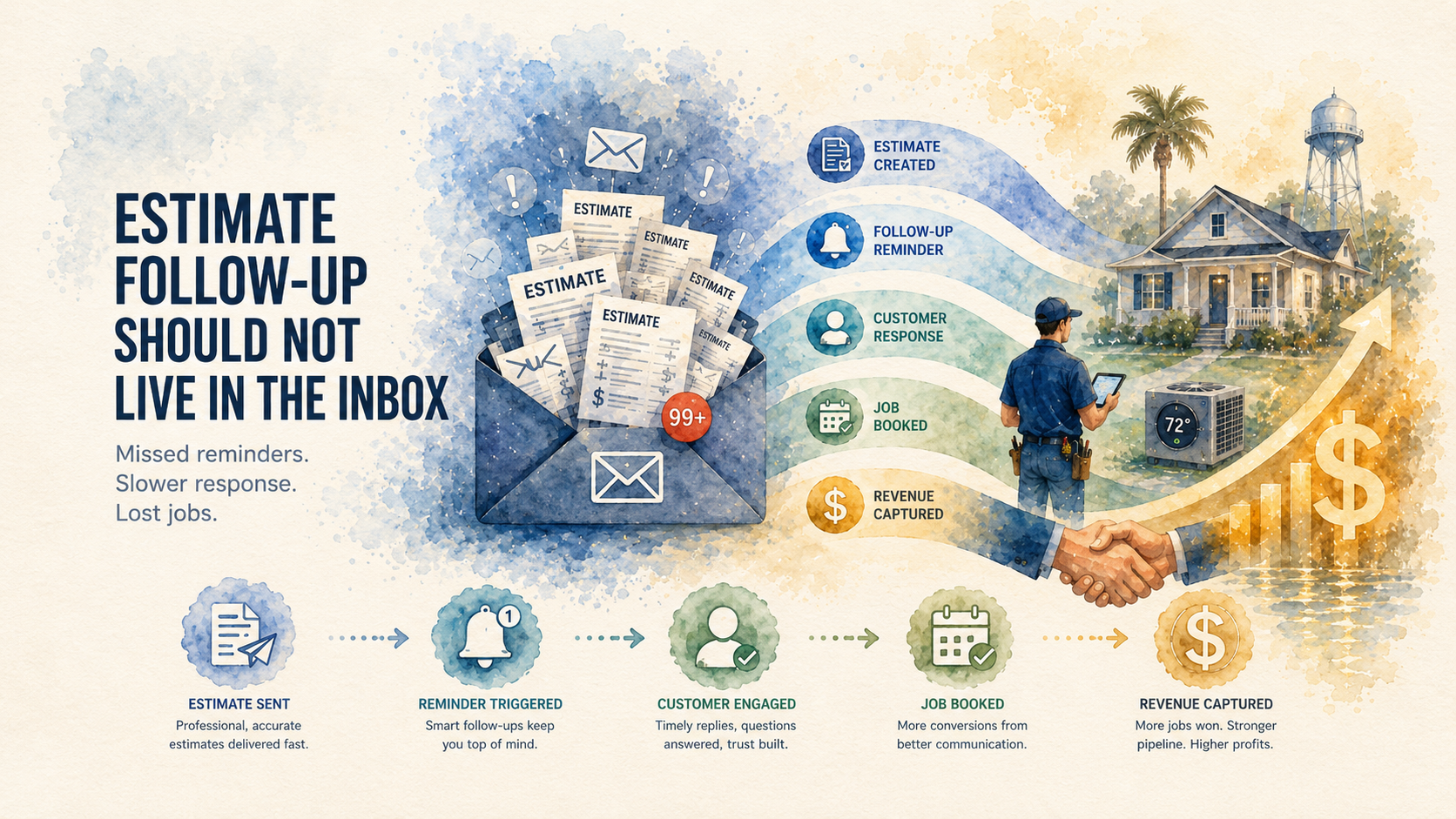
Why HVAC Companies Lose Revenue When Estimate Follow-Up Lives in the Inbox
An HVAC company can do the hard part right and still lose the job.
A technician diagnoses the issue clearly. The estimate is reasonable. The customer says they need to think about it. Then the next step depends on someone remembering to send a follow-up email, check whether the message was opened, leave a note in the CRM, or remind the comfort advisor to call again next week.
That is not a sales strategy. It is memory-based operations.
For many HVAC businesses, estimate follow-up lives across inboxes, handwritten notes, dispatch comments, and scattered CRM tasks. The result is not always obvious on a daily basis, but it shows up over time as slower response, inconsistent customer communication, stale opportunities, and jobs that should have had a better chance of closing.
The thesis is simple: HVAC companies do not need more follow-up activity for its own sake. They need a follow-up system that reliably moves every open estimate through the right next step without forcing staff to rebuild the process from scratch each time.
The Problem
Estimate follow-up tends to break down because it sits between roles.
The technician finishes the visit and records the recommendation. A service manager may need to review it. A comfort advisor may own the larger replacement opportunity. An office coordinator may send documentation. The customer may need financing details, a revised scope, or a reminder after discussing the work with a spouse.
In a busy HVAC operation, these transitions become fragile when they are handled manually.
Common failure points include:
- Estimates that are sent but never assigned a next follow-up date
- Sales notes that remain in one person’s inbox instead of the shared system
- Customers who receive a quote but no timely explanation of the next step
- Service and sales teams working from different versions of the truth
- Follow-up that happens only when the pipeline looks light
- Older estimates that are still viable but disappear under newer work
None of this requires negligence. It happens naturally when a company grows beyond what informal habits can support.
The harder the season gets, the worse this usually becomes. During peak cooling or heating demand, office teams prioritize active fires. Estimate follow-up matters, but it rarely screams the loudest. That makes it easy to postpone, and easy to lose.
Why This Gets Expensive
The cost is not just a lower close rate. It is a weaker operating rhythm around revenue that the business already worked to create.
Every estimate represents prior effort:
- Paid marketing or referral value that generated the call
- Dispatch capacity used to schedule the visit
- Technician time spent diagnosing the system
- Administrative time spent preparing or delivering the proposal
If follow-up is inconsistent, the company wastes leverage created earlier in the workflow.
There is also a customer-experience problem. Homeowners often do not reject an estimate immediately. They get busy. They compare options. They want one question answered before deciding. A calm, timely follow-up can help them move forward. A delayed or generic follow-up can make the company feel less organized than a competitor.
Inbox-based follow-up creates uneven service because it depends too heavily on who touched the opportunity last. One advisor may be excellent at keeping notes and setting reminders. Another may rely on memory. One coordinator may flag aging estimates weekly. Another may not have time. The company ends up with a process that performs differently by person rather than by design.
It also clouds management visibility. Owners and sales managers should be able to answer questions such as:
- How many estimates are awaiting first follow-up?
- Which open proposals have gone quiet for more than seven days?
- Which opportunities are waiting on the customer versus waiting on us?
- Are replacement estimates being handled differently from repair approvals?
- Where are viable jobs aging out of the pipeline?
If those answers require asking around or searching inboxes, the workflow is already too loose.
What a Better Workflow Looks Like
A better estimate follow-up workflow does not need to be overengineered. It needs to be explicit.
At a minimum, each estimate should move through a defined path:
- Estimate created
- Estimate delivered
- Follow-up owner assigned
- Next action date scheduled
- Customer response captured
- Outcome recorded
That path can still allow for nuance. A same-day repair approval is different from a full system replacement quote. A commercial maintenance proposal is different from a residential ductwork recommendation. The workflow should reflect those differences, not flatten them.
For example:
- High-value replacement quotes may trigger same-day internal review, next-day advisor follow-up, then a second reminder several days later if the homeowner has not replied.
- Smaller repair estimates may trigger a simpler reminder sequence and a status check if no decision has been recorded.
- Opportunities waiting on financing information may route to a different task queue than opportunities waiting on revised scope.
The important shift is that follow-up is no longer improvised. It is staged, visible, and auditable.
A strong system also keeps the message and the record together. If an email draft is prepared, the supporting context should be visible in the same workflow: estimate amount, equipment type, prior customer question, last contact date, and assigned owner. That prevents staff from jumping between systems just to understand what should happen next.
Where AI Actually Helps
AI is useful here when it reduces clerical friction and helps the team keep context intact.
Good uses include:
- Summarizing technician notes into a clean internal handoff
- Drafting a personalized follow-up email from approved estimate details
- Classifying whether a customer reply sounds like a question, objection, request for revision, or ready-to-schedule response
- Surfacing aging estimates that need review
- Turning messy notes into structured CRM updates for a human to approve
- Suggesting the next best administrative action based on workflow status
For example, if a technician notes that a customer is concerned about rising utility bills and received a replacement estimate, AI can help draft a concise follow-up that references the real concern without inventing anything:
Thanks for taking time to review the system replacement estimate. Based on the concerns you raised about reliability and monthly operating cost, we can walk through the recommended option again and answer any questions before you decide.
That saves time without pretending the system should decide what to sell.
AI can also reduce the dead time between events. A reply that says, “Can you send financing details?” should not wait until someone notices it in a crowded inbox. It can be detected, routed, and turned into a task for the correct person, with the conversation summarized so the next response is faster and cleaner.
This is where automation and AI complement each other. Automation manages the state of the workflow. AI helps interpret unstructured notes and messages inside that workflow. Used together, they make follow-up more consistent without making it robotic.
Where Humans Should Stay Involved
HVAC estimate follow-up is not a good place for unsupervised improvisation.
Humans should stay involved in:
- Pricing discussions
- Scope changes
- Financing explanations that require precision
- Handling frustration or service recovery
- Deciding when to stop follow-up
- Approving outbound messages when the context is sensitive or ambiguous
The company should also be careful about over-automating tone. A homeowner deciding whether to replace a major comfort system does not need a barrage of mechanically timed nudges. They need clear, timely communication that respects the seriousness of the purchase.
That is why the best workflow is usually not “send everything automatically.” It is “prepare the right next step automatically, then let a person approve or act where judgment matters.”
In many businesses, that distinction is the difference between a helpful system and a spam machine.
A Practical Starting Point
The best first project is not a full sales operations rebuild. It is a contained estimate follow-up workflow for one high-value category.
A practical starting scope might be:
- Residential replacement estimates above a chosen dollar threshold
- Estimates marked as delivered but not accepted or declined
- A required follow-up owner and next action date
- One internal aging report or queue
- AI-assisted message drafting with human approval
- A small set of outcome statuses, such as scheduled, awaiting customer, revision requested, lost, or no response
That is enough to create operational clarity without forcing a massive software change.
From there, the business can evaluate:
- Whether first follow-up happens faster
- Whether open estimates stay cleaner
- Whether managers have better visibility into aging proposals
- Whether staff spend less time reconstructing context
- Whether customers receive more consistent communication
If those basics improve, the company can extend the same logic to repair approvals, maintenance plan renewals, unsold service recommendations, or financing-related handoffs.
The point is to start with a workflow where missed follow-up already has visible cost and where better system design can create immediate discipline.
Final Thought
HVAC companies do not usually lose estimate revenue because nobody cares. They lose it because the follow-up process is too easy to drop when the team gets busy.
Inbox-driven operations hide that problem until it becomes a pattern. A cleaner workflow makes the handoff visible, the next action explicit, and the pipeline easier to manage. AI can help by reducing note cleanup, preparing drafts, and interpreting responses, but the real gain comes from building a system that no longer depends on memory.
If your team is spending hours every week tracking open estimates, rewriting follow-up messages, or trying to determine which opportunities still need attention, Palmetto Intelligence can help turn that into a cleaner, faster, more reliable system.