
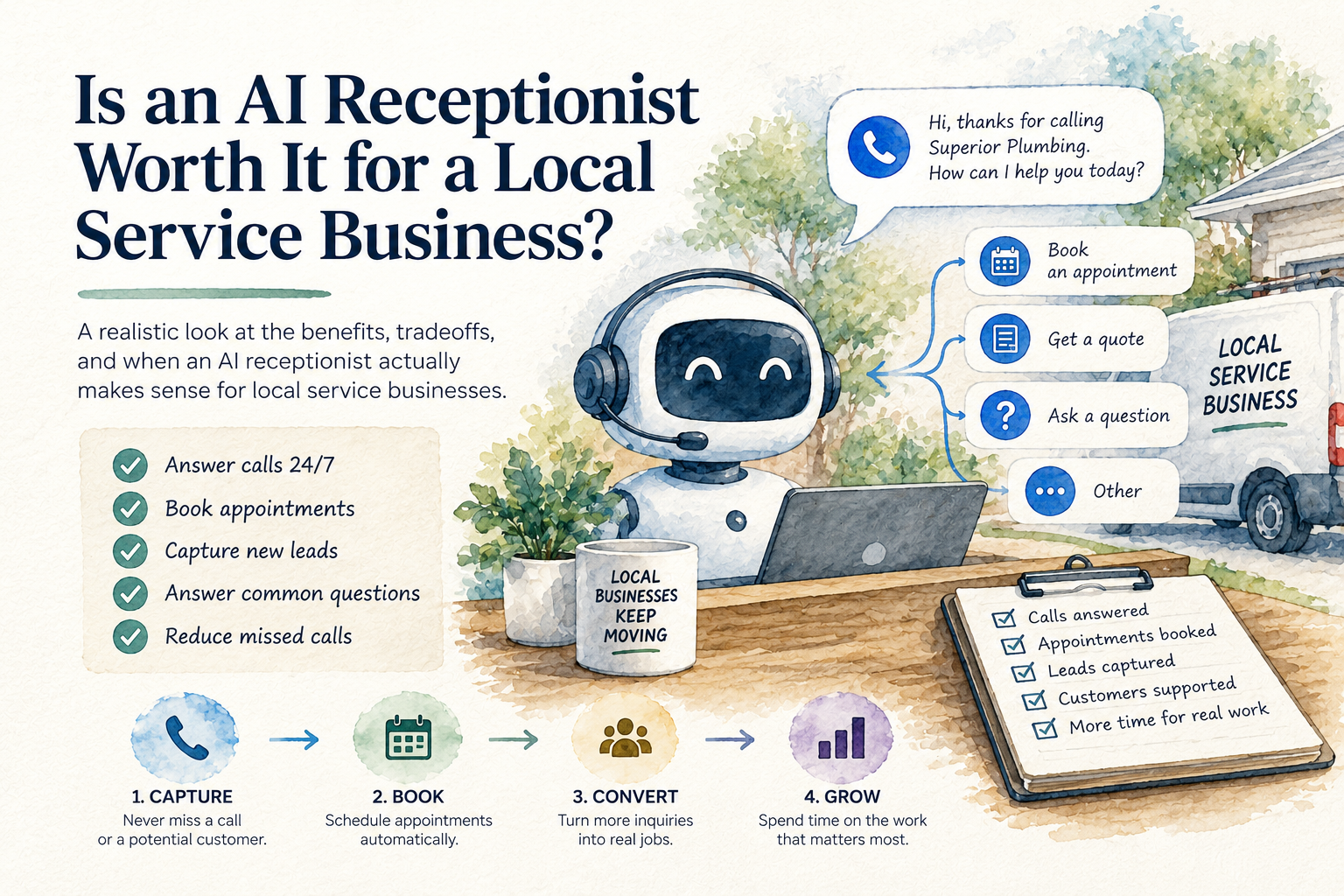
For the first time in 40 years, everyone at Superior Plumbing could attend the company Christmas party. Nobody had to stay behind to answer the phone. The Atlanta-area business had put an AI agent called Piper on duty, with a manager available for calls that needed a person. According to ServiceTitan's account of the deployment, the company also went through Thanksgiving and Christmas without assigning a customer service representative to work those holidays.
That is an easier benefit to understand than a claim about how human an AI voice sounds. Anyone who has covered a business phone knows the problem: you can spend a long time waiting for it to ring, then get several calls while you're trying to help one person. Paying for enough coverage to handle the busiest moment means paying for some quiet time too. The work follows the customer's schedule, which can make it surprisingly difficult to give employees a break.
Superior had been keeping extra staff available to avoid making callers wait. In the case study, its CRM specialist, Melissa Mohr, describes wanting employees to have more time for customers who needed a live person. The holiday coverage was one visible result. There was still someone responsible for escalations, so the company could let routine calls proceed without keeping the entire service desk staffed.
Riley Plumbing Heating & Air went further. Its ServiceTitan case study reports that the call booking rate rose from below 50% to 80%. The AI handles incoming calls and books against available capacity, while staff deal with exceptions and callbacks. The account includes a furnace failure on the Sunday before Christmas: the system booked, scheduled, and dispatched the job while the team was with family. These are vendor-published results, and neither case study establishes what another contractor should expect to earn. They do show that businesses are giving AI responsibility beyond taking a message.
A customer who has an appointment can stop calling around. An employee who returns to a scheduled job has less work waiting than one who returns to a transcript and still has to reach the caller. To deliver that difference, the receptionist needs access to the company's actual availability and permission to use it. Giving an AI the business hours and a friendly greeting would leave most of that work unfinished. This is why I would want to see what happens on the scheduling screen during a demonstration.
Of course, owners have spent years hearing complaints about automated phone systems. It would be strange to dismiss that experience just because the newest system speaks more naturally. Getting trapped in a conversation with something that cannot help is frustrating, however pleasant its voice.
A 2023 study in Production and Operations Management examined a telecommunications company's introduction of voice AI in place of a traditional phone-menu system. Customer complaints fell persistently, even though the time spent with the machine and requests for human assistance initially increased. When speech recognition failed, complaints and demands for a person increased. This was an earlier voice system in a large telecom company, so it provides evidence about that setting rather than a performance forecast for today's AI receptionists.
Those customers were already dealing with an automated menu. A voice system gave them a different way through it, and complaints declined. An owner comparing AI with an excellent receptionist is considering a different change from an owner whose customers currently wait on hold or leave messages overnight. I would expect those businesses to have different experiences, even if they bought the same software. The starting point belongs in the decision.
There is also evidence for putting AI beside the employee. In Generative AI at Work, published in the Quarterly Journal of Economics in 2025, researchers studied 5,172 customer support agents as an AI assistant was introduced. Issues resolved per hour increased by 15% on average. Less experienced and lower-skilled agents benefited most; the most experienced and highest-skilled agents saw small speed gains and small declines in quality. The employees were handling text conversations with AI assistance. They were still doing the customer service work themselves.
That finding gives an owner with a capable receptionist another possibility to consider. An employee might need help finding answers or preparing follow-up more than the business needs a new voice on the phone. It also gives me a reason to be skeptical of a sales pitch that assigns the same savings to every employee. If someone already knows the customers and handles the difficult calls well, their time has a different value from time spent collecting information that the booking system could capture.
For an owner considering the expense, I'd want to identify the part of the day that would actually change. Perhaps the office regularly has to interrupt a customer to answer another line. Perhaps an employee stays late for calls that could be booked directly. Those situations give a trial something to prove. A business that already answers promptly and books efficiently may have much less to gain from changing its reception.
I would follow a few of those appointments through the business before deciding to keep the service. A booking that employees have to correct or chase down hasn't saved them much. But when the customer has a confirmed visit and the office can get on with other work, the change is tangible. The cost calculation can include the time the team actually got back. An owner who has been covering the phone every evening may value that time quite differently from someone whose office already runs comfortably. I'd want that owner's experience in the calculation, too.